Why Most Panther Tattoos Fail
On the Panther
The panther is one of the most common designs in tattooing—and one of the easiest to get wrong.
It shows up everywhere: flash sheets, portfolios, walk-in requests.
Because of that, it’s often treated as a simple design.
It isn’t.
A strong panther works for very specific reasons.
And when those are ignored, the result is a tattoo that looks finished at first—but quickly loses clarity in the skin.
Most of the time, the problem isn’t technique.
It’s understanding.
The Real Issue
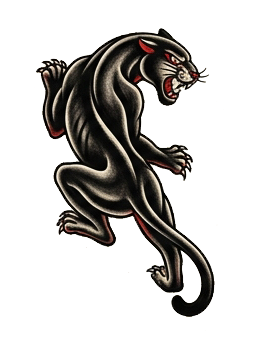
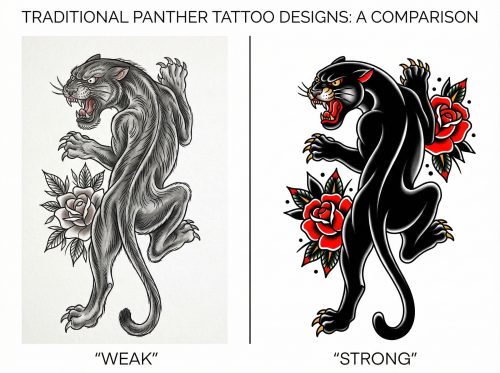
Most panthers are drawn like illustrations.
More detail is added.
More anatomy is pushed in.
More rendering is used to “improve” the design.
But none of that solves the actual problem.
Because a panther is not meant to function as a detailed image.
It’s meant to function as a tattoo shape.
And those are not the same thing.
The Principle Most People Miss
A traditional panther works because of one thing:
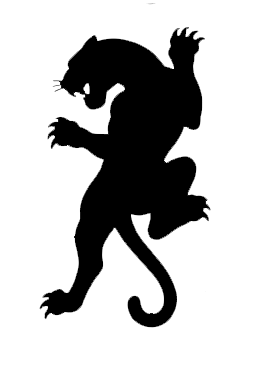
It reads as a solid black shape first.
Not teeth.
Not fur.
Not expression.
Shape.
If you remove all detail from a strong panther, it will still:
- read clearly from a distance
- carry a clear direction across the body
- hold together as one unified form
Most weak designs fall apart immediately when reduced this way.
They rely on information instead of structure.
What Goes Wrong
When the structure isn’t understood, the same problems show up over and over:
The silhouette breaks
The body is built in pieces instead of as a single shape.
Too much internal detail
Lines compete with each other instead of supporting the design.
Weak black placement
Instead of bold areas, the black is fragmented and loses impact.
Overworked rendering
Shading is used to fix problems that should have been solved in the drawing.
All of these lead to the same result:
A tattoo that looks acceptable up close—but loses strength at a distance, and over time.
What Actually Makes It Work
A strong panther is designed, not illustrated.
It starts with a controlled black mass.
The movement of the body is decided early.
The silhouette is clear before anything else is added.
Details are used carefully—and only where they reinforce the main shape.
Nothing is random.
Nothing is decorative for its own sake.
Every part of the design supports readability.
That’s why traditional panthers last.
Not because they are simple—
but because they are built correctly from the beginning.
What This Means
If you understand the role of shape, you’re already ahead of most.
But the real difference comes from how that shape is constructed—
how the head, spine, and body work together to create movement and balance.
That’s where most designs either hold together—or fall apart completely.
(Full breakdown of structure, construction, and shading in the complete guide.)